Recovery
BPC-157 vs TB-500: The Key Differences Explained
BPC-157 and TB-500 are often named together, but they are very different peptides. Here is what each one is, what research has studied, and how thin the human evidence still is.
October 29, 2026 · 6 min read
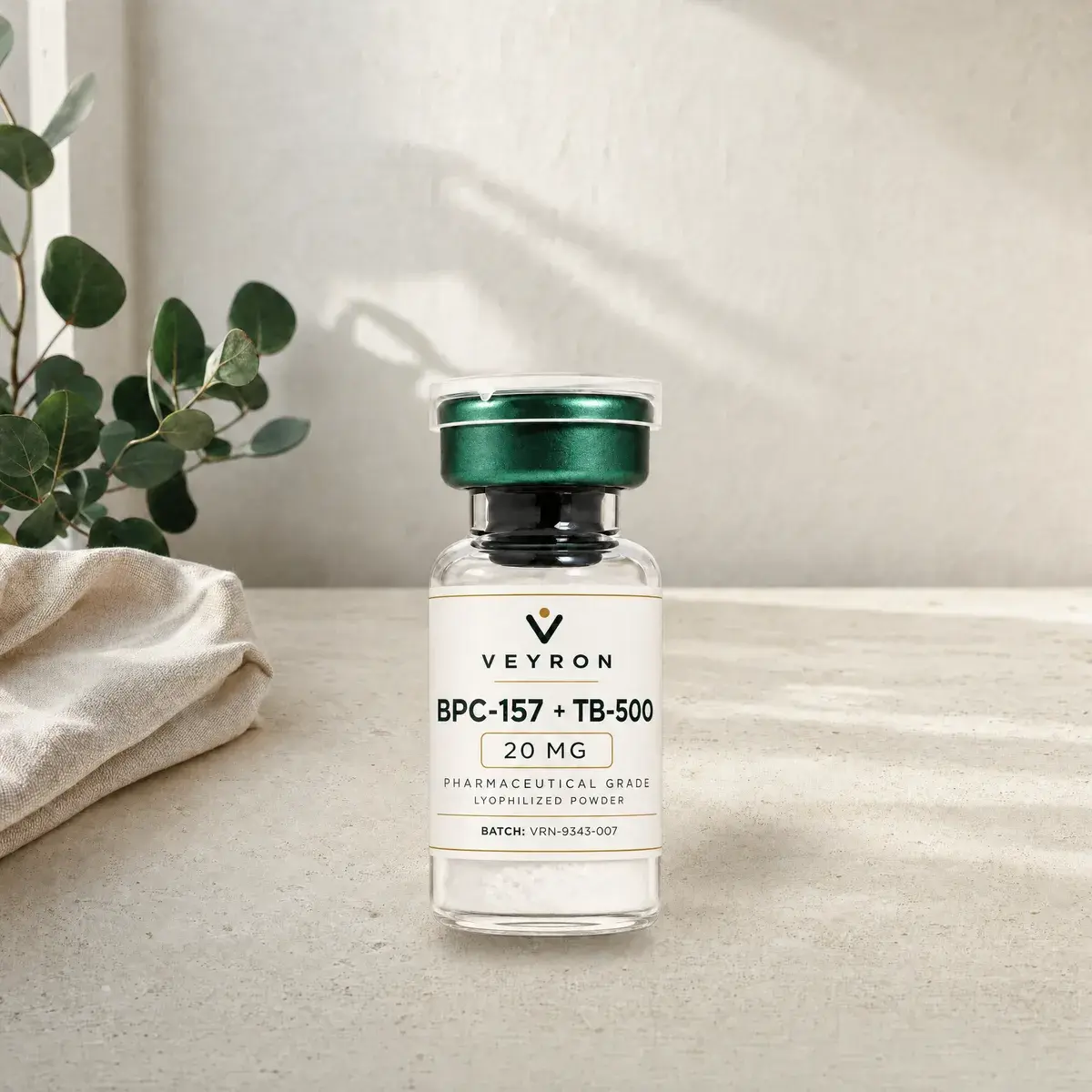
If you have spent any time reading about recovery research, you have almost certainly seen BPC-157 and TB-500 mentioned side by side. They are often treated as a pair, yet they come from completely different places and have different research histories. This guide walks you through what each one is, what has actually been studied, and where the evidence honestly stands today.
Where each peptide comes from
BPC-157: a fragment from the stomach
BPC-157 is a pentadecapeptide, a short chain of 15 amino acids. It is a partial sequence of a larger protein called body protection compound, which was originally isolated from human gastric juice. That origin explains why so much of the early research looked at the stomach and gut lining. The BPC-157 used in research today is made synthetically.
TB-500: built on thymosin beta-4
Thymosin beta-4 (often written Tβ4) is a naturally occurring peptide of 43 amino acids, present in nearly every cell type. After an injury it is released by platelets, macrophages and other cells, and one of its main jobs is binding actin, the protein that lets cells move and change shape.
The name TB-500 needs a short explanation. It first appeared as a veterinary preparation, and doping-control laboratories identified its key ingredient as a small active region of thymosin beta-4: the acetylated fragment made of amino acids 17 to 23 (Ac-LKKTETQ), the part linked to actin binding and cell migration. Today the name is also widely used for synthetic full-length thymosin beta-4, which is what Veyron's TB-500 is. This matters when you read studies, because most of the published research concerns full thymosin beta-4, not the short fragment.
What preclinical research has studied
Almost everything known about both peptides comes from cell cultures and animal models. That is an important starting point, because results in rats do not automatically carry over to people.
BPC-157: tendon, muscle, bone and gut
A 2025 systematic review in HSS Journal gathered the orthopaedic literature on BPC-157 and included 36 studies, of which 35 were preclinical. In those animal models, BPC-157 was associated with better functional, structural and biomechanical outcomes after muscle, tendon, ligament and bone injuries. Classic examples are rat studies on a cut Achilles tendon or a damaged quadriceps muscle. The reviewed studies point to effects on pathways involved in cell growth and the formation of new blood vessels (angiogenesis), and to lower levels of inflammatory signalling molecules. Separately, a large body of animal work has looked at the gut lining, in line with the peptide's gastric origin.
Thymosin beta-4: wounds, migration and blood vessels
Research on thymosin beta-4 has a different emphasis. In a well-known 1999 study in rats with full-thickness skin wounds, Tβ4 applied topically or by injection increased re-epithelialisation by 42% over saline at day 4 and by up to 61% at day 7, with more collagen deposition and new blood vessel growth in the treated wounds. A 2012 review describes Tβ4 as promoting cell migration, helping mobilise progenitor cells that form new blood vessels, and reducing the number of myofibroblasts, which is linked to less scarring. Research has covered skin, eye, heart and brain tissue.
Human evidence: precise and honest
This is where the two peptides look most alike: the human evidence for both is very limited.
- BPC-157: the 2025 systematic review found only one clinical study. It was a retrospective chart review of 16 people with knee pain who had received a knee injection of BPC-157, in four cases combined with thymosin beta-4. Follow-up was a phone survey, there was no control group and no standardised measurement tools were used. The review authors found no clinical safety data. BPC-157 is not an approved medicine in the EU or the US.
- Thymosin beta-4: full-length Tβ4 has reached small clinical trials in specific settings. One example is a phase 2 trial in nine people with severe dry eye, using Tβ4 eye drops, which reported improvements in discomfort and corneal staining compared with a placebo solution. That is a topical eye product, so it tells you nothing about muscle or tendon. For the short TB-500 fragment itself, we found no published controlled human trials.
Both BPC-157 and thymosin beta-4 (including TB-500) are on the World Anti-Doping Agency's prohibited list, which is worth knowing if you work with competitive athletes.
Why they are so often combined
The reasoning behind pairing them comes from their different research profiles. BPC-157 is mostly discussed in terms of blood vessel growth and protection of tissues such as tendon and gut lining. Thymosin beta-4 is mostly discussed in terms of actin regulation and guiding cells to where repair is needed. Researchers therefore see them as approaching the same question from two angles.
It is important to be clear about one thing: the combination itself has hardly been studied. Apart from the four patients in that single chart review, there is no published human data on BPC-157 and TB-500 together, and no controlled trials. The appeal of a BPC-157 + TB-500 blend is mainly practical: one vial to prepare instead of two, with a fixed equal ratio.
Key differences at a glance
| BPC-157 | TB-500 / thymosin beta-4 | |
|---|---|---|
| Origin | Partial sequence of a protein from human gastric juice | Based on thymosin beta-4, found in almost every cell |
| Size | 15 amino acids | 43 amino acids (full Tβ4); 7 in the original fragment |
| Main research focus | Tendon, ligament, muscle, bone, gut lining | Wound healing, cell migration, skin, eye, heart |
| Proposed mechanism | Growth and blood vessel pathways, lower inflammatory signals | Actin binding, cell migration, new blood vessels |
| Human evidence | One small retrospective chart review | Small trials of full Tβ4 in specific settings; none found for the fragment |
| Anti-doping status | Prohibited (WADA) | Prohibited (WADA) |
Choosing what fits your research
If your work centres on tendon, ligament or gut models, the BPC-157 literature is the larger body to build on. If you are interested in wound healing, cell migration or tissue remodelling, thymosin beta-4 has the deeper background. If you want to look at both, the blend saves a preparation step. You can browse everything in our recovery collection, or let the Peptide Finder narrow down the options for you in a few questions.
Sources
- Vasireddi N, Hahamyan H, Salata MJ, et al. Emerging Use of BPC-157 in Orthopaedic Sports Medicine: A Systematic Review. HSS Journal. 2025;21(4):485-495. doi:10.1177/15563316251355551
- Lee E, Padgett B. Intra-Articular Injection of BPC 157 for Multiple Types of Knee Pain. Alternative Therapies in Health and Medicine. 2021;27(4):8-13. PubMed 34324435
- Malinda KM, Sidhu GS, Mani H, et al. Thymosin beta4 accelerates wound healing. Journal of Investigative Dermatology. 1999;113(3):364-368. doi:10.1046/j.1523-1747.1999.00708.x
- Goldstein AL, Hannappel E, Sosne G, Kleinman HK. Thymosin β4: a multi-functional regenerative peptide. Basic properties and clinical applications. Expert Opinion on Biological Therapy. 2012;12(1):37-51. doi:10.1517/14712598.2012.634793
- Sosne G, Dunn SP, Kim C. Thymosin β4 significantly improves signs and symptoms of severe dry eye in a phase 2 randomized trial. Cornea. 2015;34(5):491-496. doi:10.1097/ICO.0000000000000379
- Esposito S, Deventer K, Goeman J, et al. Synthesis and characterization of the N-terminal acetylated 17-23 fragment of thymosin beta 4 identified in TB-500. Drug Testing and Analysis. 2012;4(9):733-738. doi:10.1002/dta.1402
This article is for information only and is not medical advice. The research described here mostly involves animals and cell cultures. If you have questions about your health, please talk to a doctor.
Mentioned in this article
Not sure which one fits you?
Answer a few questions and the Peptide Finder suggests a match in 60 seconds.