Muscle & performance
CJC-1295 with or without DAC: what's the difference?
Same name, two different peptides. What DAC does to half-life, what the studies found on GH pulses, and how ipamorelin and sermorelin fit in.
October 29, 2026 · 7 min read
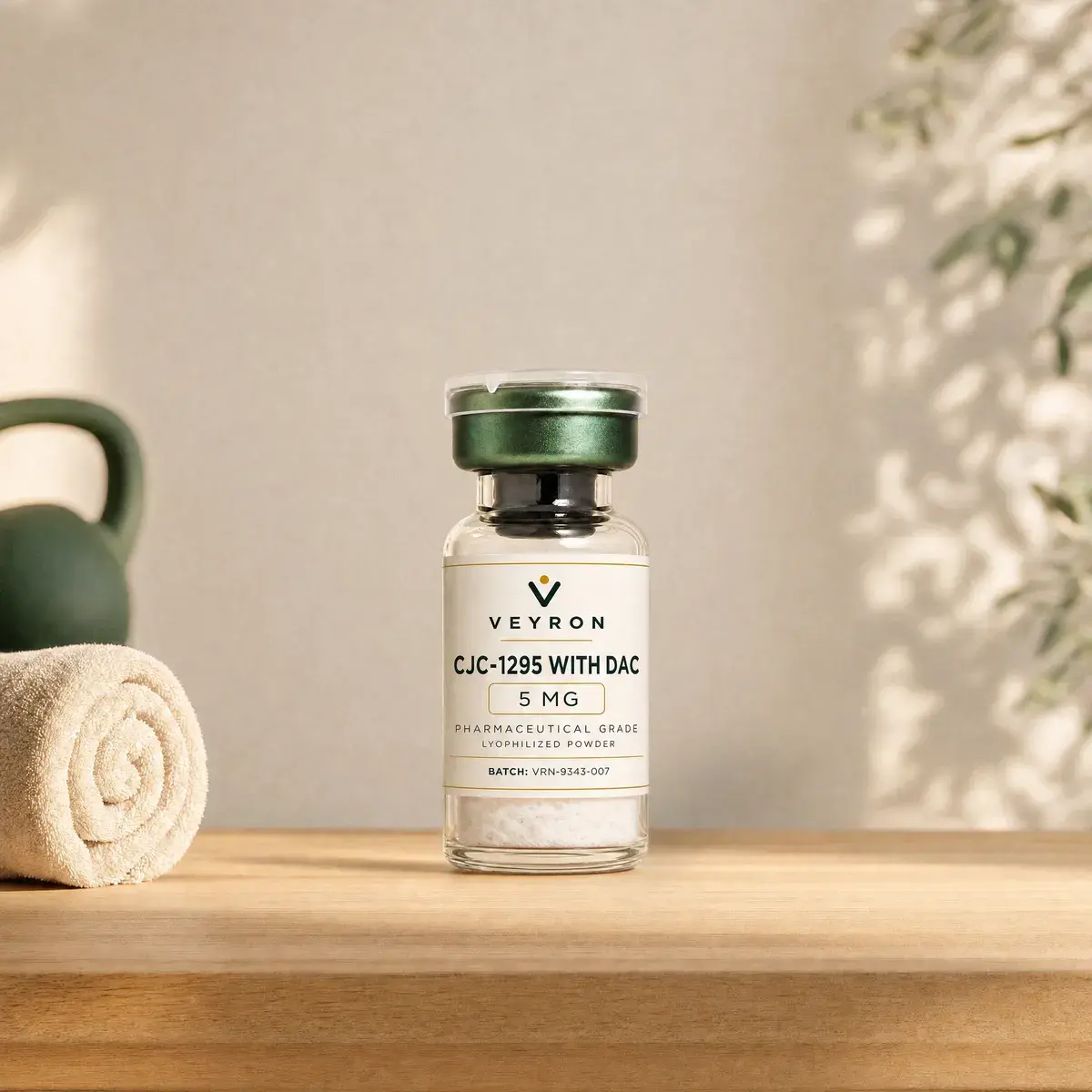
"CJC-1295" is printed on two quite different research peptides, and the only thing that tells them apart is three letters: DAC. One version stays in circulation for days, the other for a much shorter time. Here is what DAC actually is, what the published studies measured for each version, and where ipamorelin and sermorelin fit into the picture.
Two peptides, one name
Both versions start from the same template: the first 29 amino acids of growth hormone-releasing hormone (GHRH), the hypothalamic signal that tells the pituitary to release growth hormone (GH). That 29-amino-acid fragment is short, but research has long shown it carries the full biological activity of the natural hormone. Sermorelin is exactly that fragment.
CJC-1295 is a tetrasubstituted version of GRF(1-29): four amino acids are swapped to make the peptide more resistant to breakdown. From there, the two products split:
- CJC-1295 without DAC, also sold as modified GRF (1-29) or "mod GRF", is the modified peptide on its own.
- CJC-1295 with DAC has an extra chemical group attached that lets it bind to albumin in the blood. This is the compound that was actually named and tested as CJC-1295 in the original papers.
That naming detail matters when you read research: almost all published data on "CJC-1295" refer to the DAC version.
What DAC does: binding to albumin
DAC stands for Drug Affinity Complex. In practice it is a reactive group (a maleimide derivative attached to a lysine at the end of the peptide) that forms a bond with albumin, the most abundant protein in blood. Albumin circulates for weeks, so a peptide that hitches a ride on it is shielded from rapid clearance.
The rat study that identified CJC-1295 (Jetté et al., 2005) showed this directly: the compound was found bound to serum albumin within 15 minutes of injection and was still detectable in plasma beyond 72 hours. Over a two-hour window it produced a fourfold larger GH response (area under the curve) than unmodified GRF(1-29). These are animal data, but they explain the design idea.
What the human studies measured
CJC-1295 with DAC was studied in healthy adults in two small clinical studies published in 2006.
Half-life and IGF-1 (Teichman et al., 2006)
In a randomized, placebo-controlled study with single and repeated injections, the estimated half-life of CJC-1295 was 5.8 to 8.1 days. After a single injection, mean GH levels rose two- to tenfold for six days or more, and IGF-1 (the hormone the liver releases in response to GH) rose 1.5- to threefold for 9 to 11 days. With repeated injections, mean IGF-1 stayed above baseline for up to 28 days.
Pulsatility (Ionescu & Frohman, 2006)
A natural concern with a long-acting compound is that it might flatten the body's normal rhythm, in which GH is released in pulses, mostly at night. This study sampled blood every 20 minutes overnight in healthy men, before and one week after a single injection. The pulses were still there: their frequency and size were unchanged. What changed was the baseline: trough GH levels between pulses rose about 7.5-fold, mean GH rose 46% and IGF-1 rose 45%.
So the accurate summary is not "DAC destroys pulsatility", but rather: pulses were preserved, while the floor between them was raised substantially and continuously.
Without DAC: a short-acting signal
Without the albumin-binding group, modified GRF(1-29) is cleared much faster and behaves more like a brief, pulse-shaped signal, similar to what the hypothalamus sends naturally. That is why researchers interested in short, discrete GH pulses tend to look at the no-DAC version, and those interested in a sustained elevation look at the DAC version.
One honest caveat: unlike the DAC version, modified GRF(1-29) has very little published human data of its own. Much of what is said about it is inferred from GHRH and sermorelin research rather than from dedicated clinical trials.
| CJC-1295 with DAC | CJC-1295 without DAC | Sermorelin | |
|---|---|---|---|
| Structure | Modified GRF(1-29) + albumin-binding group | Modified GRF(1-29) | Unmodified GRF(1-29) |
| Duration in circulation | Days (half-life 5.8–8.1 days in humans) | Short | Short |
| GH pattern studied | Pulses preserved, raised baseline | Brief, pulse-like release | Brief, pulse-like release |
| Published human data | Two small 2006 studies | Very limited | Clinical use in pediatric diagnostics and GH deficiency |
Why ipamorelin is often paired with it
Ipamorelin works through a different route. It is a growth hormone-releasing peptide (GHRP), acting on the receptor now known as the ghrelin receptor rather than the GHRH receptor. In the 1998 study that introduced it (Raun et al.), ipamorelin released GH in rats and pigs with a potency similar to GHRP-6, but, unlike GHRP-6 and GHRP-2, it did not raise ACTH or cortisol beyond the levels seen with GHRH, even at very high doses. That selectivity is why it is described as the first selective GH secretagogue. These findings are from animal studies.
The rationale for combining the two classes goes back further. In a 1990 study in healthy men, Bowers and colleagues found that a GHRP given together with GHRH released GH synergistically, more than either alone, suggesting the two act through independent mechanisms. That is the scientific background to the CJC-1295 + ipamorelin blend. Note that the specific combination of CJC-1295 and ipamorelin has not itself been tested in published clinical trials.
Where sermorelin fits
Sermorelin is the plain GRF(1-29) fragment, without the four substitutions. It is the shortest synthetic peptide with the full activity of GHRH and has a real clinical history: it was used as a diagnostic test for GH deficiency and studied in children with idiopathic GH deficiency. Because it is broken down quickly, its effect is short-lived. You can think of it as the reference point: CJC-1295 without DAC is a more stable version of sermorelin, and CJC-1295 with DAC is that stable version made long-acting. If you want to compare them side by side, see sermorelin.
Choosing which one to study
The difference comes down to timing. The DAC version was designed and studied for a sustained, days-long rise in GH and IGF-1. The no-DAC version provides a short signal that more closely mirrors a single natural pulse. Which one fits depends on the research question, not on which is "stronger". If you are still orienting yourself, the Peptide Finder can help, and the full range is under muscle and performance.
This article is for information only and is not medical advice. The products mentioned are sold for research purposes. If you have questions about your health or hormones, please talk to a doctor.
Sources
- Teichman SL, Neale A, Lawrence B, Gagnon C, Castaigne JP, Frohman LA. Prolonged stimulation of growth hormone (GH) and insulin-like growth factor I secretion by CJC-1295, a long-acting analog of GH-releasing hormone, in healthy adults. J Clin Endocrinol Metab. 2006;91(3):799–805. PubMed 16352683 · doi:10.1210/jc.2005-1536
- Ionescu M, Frohman LA. Pulsatile secretion of growth hormone (GH) persists during continuous stimulation by CJC-1295, a long-acting GH-releasing hormone analog. J Clin Endocrinol Metab. 2006;91(12):4792–4797. PubMed 17018654 · doi:10.1210/jc.2006-1702
- Jetté L, Léger R, Thibaudeau K, et al. Human growth hormone-releasing factor (hGRF)1-29-albumin bioconjugates activate the GRF receptor on the anterior pituitary in rats: identification of CJC-1295 as a long-lasting GRF analog. Endocrinology. 2005;146(7):3052–3058. PubMed 15817669 · doi:10.1210/en.2004-1286
- Raun K, Hansen BS, Johansen NL, et al. Ipamorelin, the first selective growth hormone secretagogue. Eur J Endocrinol. 1998;139(5):552–561. PubMed 9849822 · doi:10.1530/eje.0.1390552
- Bowers CY, Reynolds GA, Durham D, et al. Growth hormone (GH)-releasing peptide stimulates GH release in normal men and acts synergistically with GH-releasing hormone. J Clin Endocrinol Metab. 1990;70(4):975–982. PubMed 2108187 · doi:10.1210/jcem-70-4-975
- Prakash A, Goa KL. Sermorelin: a review of its use in the diagnosis and treatment of children with idiopathic growth hormone deficiency. BioDrugs. 1999;12(2):139–157. PubMed 18031173 · doi:10.2165/00063030-199912020-00007
Mentioned in this article
Not sure which one fits you?
Answer a few questions and the Peptide Finder suggests a match in 60 seconds.