Weight loss
Retatrutide vs Semaglutide vs Tirzepatide: What Studies Show
Semaglutide, tirzepatide and retatrutide are related, but they act on different hormone receptors and sit at very different stages of research. Here's what the main trials found, side by side.
October 29, 2026 · 6 min read
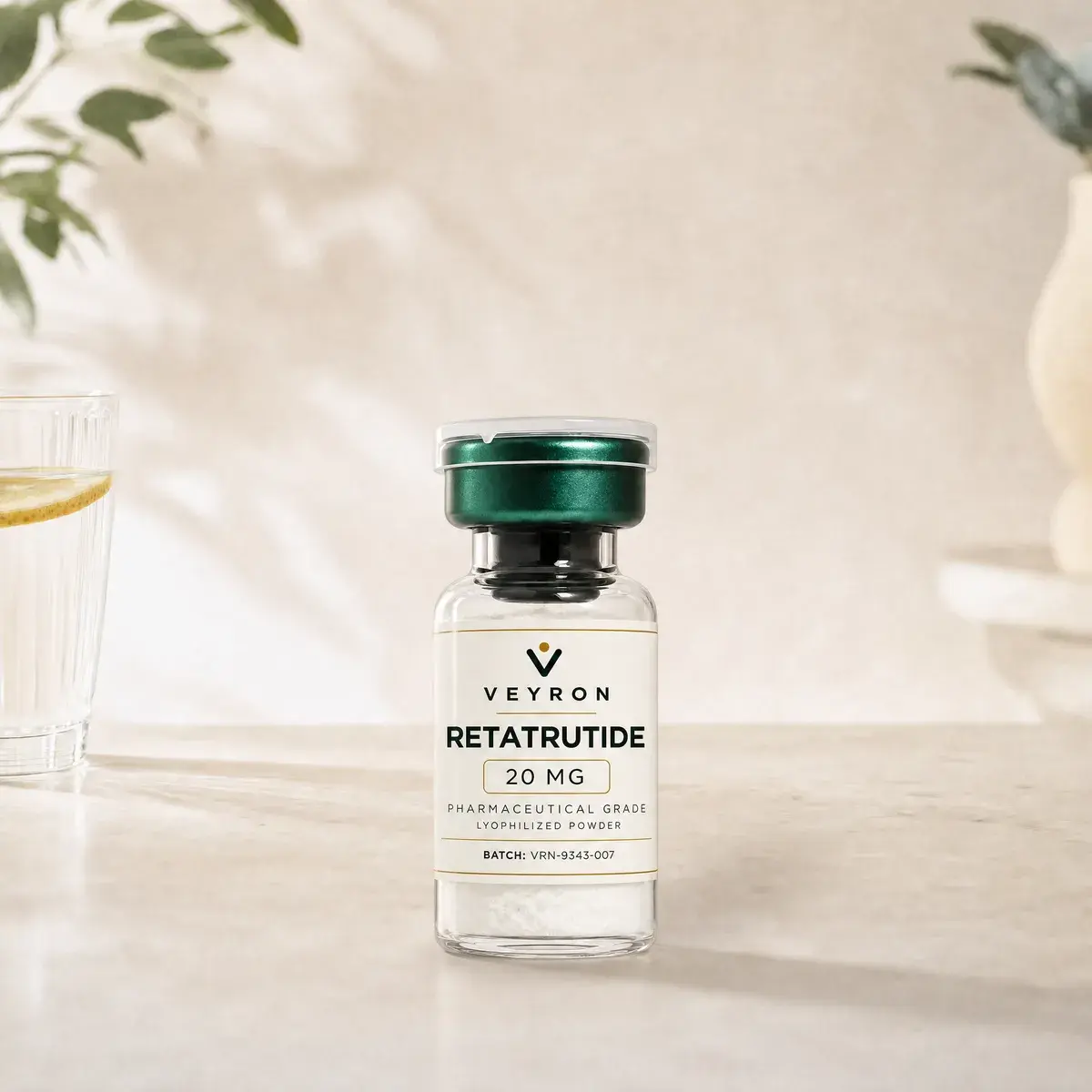
Three names keep coming up when people talk about the newer weight-loss medicines: semaglutide, tirzepatide and retatrutide. They are related, but they don't work in quite the same way, and they sit at very different stages of research. Here's a calm, plain-language look at what each one targets, what the main trials found and where the evidence still has gaps.
Three molecules, three receptor profiles
All three are peptides modelled on gut hormones that help the body regulate appetite and blood sugar. The real difference is how many hormone receptors each one activates.
- Semaglutide activates one receptor: GLP-1 (glucagon-like peptide-1).
- Tirzepatide activates two: GIP (glucose-dependent insulinotropic polypeptide) and GLP-1.
- Retatrutide activates three: GIP, GLP-1 and the glucagon receptor.
GLP-1 signalling slows stomach emptying and is involved in feelings of fullness. GIP is a second gut hormone of the same family, and researchers have been studying whether adding it changes how the body responds. The glucagon receptor is the newest piece: it is being studied for its role in energy expenditure and fat handling in the liver. Retatrutide (code name LY3437943) was described in Cell Metabolism in 2022, from the early lab and animal work through to first studies in people, as a single molecule built to combine all three signals.
The trials at a glance
The table below puts the main obesity trial for each compound side by side. Keep in mind that these were separate trials with different participants, lengths and designs, so the numbers are not a direct contest.
| Semaglutide | Tirzepatide | Retatrutide | |
|---|---|---|---|
| Receptors | GLP-1 | GIP + GLP-1 | GIP + GLP-1 + glucagon |
| Main trial | STEP 1 (phase 3), 1,961 adults | SURMOUNT-1 (phase 3), 2,539 adults | Phase 2, 338 adults |
| Trial length | 68 weeks | 72 weeks | 48 weeks |
| Mean weight change | −14.9% (placebo −2.4%) | −15.0% to −20.9% depending on dose (placebo −3.1%) | −8.7% to −24.2% depending on dose (placebo −2.1%) |
| Status in the EU | Approved medicine | Approved medicine | Investigational |
What the main trials found
Semaglutide: STEP 1
STEP 1 (NEJM, 2021) followed 1,961 adults with obesity, or overweight with at least one weight-related condition, who did not have diabetes. Alongside a lifestyle programme, they received weekly semaglutide or placebo for 68 weeks. Average body weight changed by −14.9% with semaglutide versus −2.4% with placebo. About half of the semaglutide group (50.5%) lost 15% or more of their starting weight, compared with 4.9% on placebo.
Tirzepatide: SURMOUNT-1
SURMOUNT-1 (NEJM, 2022) included 2,539 adults without diabetes over 72 weeks and tested three dose levels. Mean weight change ranged from −15.0% at the lowest dose to −20.9% at the highest, versus −3.1% with placebo. In the two higher-dose groups, 50% and 57% of participants lost 20% or more of their body weight, compared with 3% on placebo.
Retatrutide: the phase 2 trial
The retatrutide phase 2 trial (NEJM, 2023) enrolled 338 adults with obesity or overweight and ran for 48 weeks across several dose groups. At 24 weeks, the highest-dose group had changed by −17.5% versus −1.6% on placebo. At 48 weeks this reached −24.2% versus −2.1%, and 83% of the highest-dose group had lost 15% or more. These are striking figures, but a phase 2 trial is smaller and shorter than a phase 3 programme. The larger phase 3 studies (the TRIUMPH programme) are where firmer answers will come from.
Head to head: what we actually know
Only one of these pairs has been compared directly in a published randomised trial. In SURMOUNT-5 (NEJM, 2025), 751 adults with obesity but without type 2 diabetes received either tirzepatide or semaglutide for 72 weeks. Mean weight change was −20.2% with tirzepatide versus −13.7% with semaglutide, and waist circumference fell by 18.4 cm versus 13.0 cm. The trial was open-label and funded by the maker of tirzepatide, which is worth knowing when you read it.
For retatrutide, there is no published head-to-head trial against either semaglutide or tirzepatide yet. Any claim that it is "better" rests on comparing separate studies, which is exactly what the table above warns against.
Side effects reported in the trials
The pattern is similar across all three compounds: the most common adverse events were gastrointestinal (nausea, diarrhoea, vomiting, constipation). In each trial these were mostly mild to moderate and appeared mainly while the dose was being stepped up.
- STEP 1: 4.5% of the semaglutide group stopped treatment because of gastrointestinal events, versus 0.8% on placebo.
- SURMOUNT-1: adverse events led to stopping treatment in 4.3% to 7.1% of the tirzepatide groups, versus 2.6% on placebo.
- Retatrutide phase 2: gastrointestinal events were dose-related and were partly reduced with a lower starting dose. The researchers also reported dose-dependent increases in heart rate that peaked at 24 weeks and declined afterwards.
All of these trials took place under close medical supervision, with screening beforehand. For retatrutide in particular, long-term safety data are still being collected.
Approved or still investigational?
This is perhaps the biggest practical difference. Semaglutide is an approved medicine in the EU, as Ozempic for type 2 diabetes and Wegovy for weight management. Tirzepatide is approved in the EU as Mounjaro, for type 2 diabetes and for weight management. Retatrutide is not approved by the EMA or the FDA: it is still an investigational compound, studied in clinical trials.
How they differ, in short
- Mechanism: one receptor (semaglutide), two (tirzepatide) or three (retatrutide).
- Evidence base: large phase 3 programmes and years of real-world use for semaglutide and tirzepatide; a phase 2 trial plus an ongoing phase 3 programme for retatrutide.
- Direct comparison: tirzepatide outperformed semaglutide in SURMOUNT-5; retatrutide has not yet been tested head to head.
- Side effects: mainly gastrointestinal for all three, with a heart-rate signal noted in the retatrutide phase 2 trial.
If you're looking into these compounds for research, you'll find retatrutide, semaglutide and tirzepatide in our shop, as well as the Veyron Pen · Retatrutide. Related compounds are grouped on the weight-loss goal page, and if you're not sure where to begin, the Peptide Finder asks a few short questions and points you in the right direction.
This article is for information only and is not medical advice. It describes published research, not recommendations for use. If you're considering any weight-loss treatment, please talk to your doctor.
Sources
- Wilding JPH, Batterham RL, Calanna S, et al. Once-Weekly Semaglutide in Adults with Overweight or Obesity. N Engl J Med. 2021;384(11):989–1002. PubMed · DOI
- Jastreboff AM, Aronne LJ, Ahmad NN, et al. Tirzepatide Once Weekly for the Treatment of Obesity. N Engl J Med. 2022;387(3):205–216. PubMed · DOI
- Jastreboff AM, Kaplan LM, Frías JP, et al. Triple-Hormone-Receptor Agonist Retatrutide for Obesity – A Phase 2 Trial. N Engl J Med. 2023;389(6):514–526. PubMed · DOI
- Aronne LJ, Horn DB, le Roux CW, et al. Tirzepatide as Compared with Semaglutide for the Treatment of Obesity. N Engl J Med. 2025;393(1):26–36. PubMed · DOI
- Coskun T, Urva S, Roell WC, et al. LY3437943, a novel triple glucagon, GIP, and GLP-1 receptor agonist for glycemic control and weight loss: From discovery to clinical proof of concept. Cell Metab. 2022;34(9):1234–1247.e9. PubMed · DOI
Mentioned in this article
Semaglutide
The classic for appetite and weight
from €64.95
View product Chosen 6×
Tirzepatide
Dual action for appetite and weight
from €64.95
View product Chosen 24×
Retatrutide
Appetite control & weight management
from €99.95
View product Chosen 25×
Veyron Pen · Retatrutide
Retatrutide in an easy all-in-one pen
from €179.95
View product
Not sure which one fits you?
Answer a few questions and the Peptide Finder suggests a match in 60 seconds.